With the rapid pace of infrastructure development across the country, the construction industry has witnessed a remarkable transformation over the past decade. By embracing technological advancements, new-age construction methods have made projects more efficient, cost-effective, and faster to deliver. The industry continues to adopt innovative techniques and modern methodologies to ensure superior construction quality and timely project completion.
Construct-Tech is dedicated to exploring the latest innovations transforming the construction industry. From cutting-edge building materials and advanced construction equipment to automation, digital modeling, and sustainable technologies — this section highlights how modern engineering is reshaping the way we build.
Here, you’ll find:
- Image carousels that visually explain new construction technologies.
- YouTube videos showcasing the practical, on-site applications of these technologies.
- Project highlights where these innovations have been successfully implemented worldwide.
Whether you’re a civil engineering student, construction professional, or tech enthusiast, Construct-Tech helps you stay informed about the future of construction technology and its real-world impact.

Below mentioned are the new methods and techniques which have been established by now in the industry and is being successfully implemented in multiple construction projects.
1. New Austrian Tunnel Method (NATM)
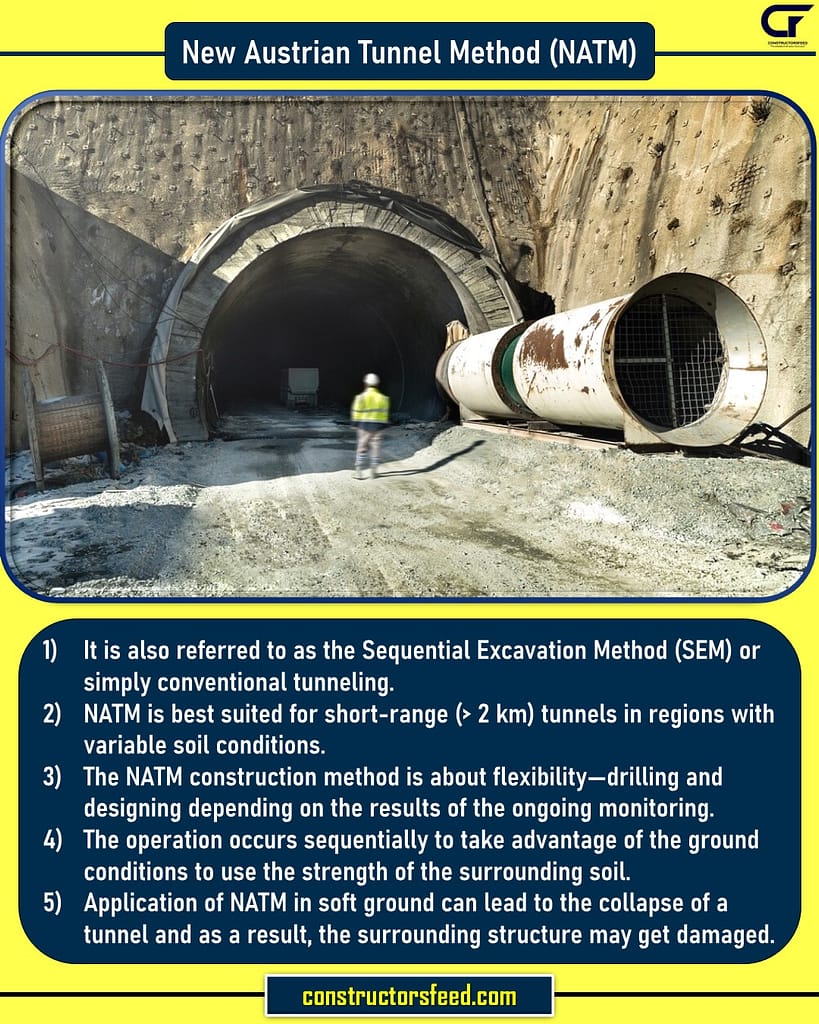
Major Projects Utilizing NATM in India
1. Zojila Tunnel, Jammu & Kashmir
- Length: 14.15 km
- Significance: India’s longest road tunnel and Asia’s longest bidirectional tunnel.
- Purpose: Provides year-round connectivity between Srinagar and Ladakh.
- Construction Method: Implemented using NATM due to the challenging Himalayan geology.
2. USBRL Tunnel 50, Jammu & Kashmir
- Length: 12.775 km
- Project: Part of the Udhampur-Srinagar-Baramulla Rail Link (USBRL).
- Features: India’s longest transportation tunnel, constructed using NATM to navigate the region’s complex terrain.
3. Atal Tunnel, Himachal Pradesh
- Length: 9.02 km
- Purpose: Connects Manali to Lahaul-Spiti valley, ensuring all-weather connectivity.
- Construction Technique: Built using the Drill & Blast method combined with NATM principles to address the high-altitude and challenging geological conditions.
4. Sela Tunnel, Arunachal Pradesh
- Length: 12.04 km
- Objective: Ensures all-weather connectivity between Guwahati and Tawang, enhancing strategic mobility.
- Construction Method: Executed using NATM to tackle the high-altitude and fragile geological conditions of the region.
5. New Katraj Tunnel, Maharashtra
- Length: 1.2 km
- Location: Situated on NH 48 near Pune.
- Construction: Built using NATM, replacing the older tunnel to improve traffic flow and safety.
6. Delhi Metro – Chawri Bazar Station
- Challenge: Located in a densely populated area with complex ground conditions.
- Solution: NATM was employed for the station’s construction, allowing for minimal surface disruption and adaptability to the urban environment.
7. Sungal Tunnel, Jammu & Kashmir
- Project: Part of the Jammu–Poonch highway alignment.
- Construction Method: Utilized NATM to address the region’s challenging geological conditions.
Sector-Wide Adoption of NATM
According to India Infrastructure Research, NATM has been implemented in approximately 51 tunnel projects across India, covering a combined length of about 300 km. The highest deployment has been in the hydro sector (23 projects), followed by the metro rail sector (14 projects).
2. Doka Table Lifting System
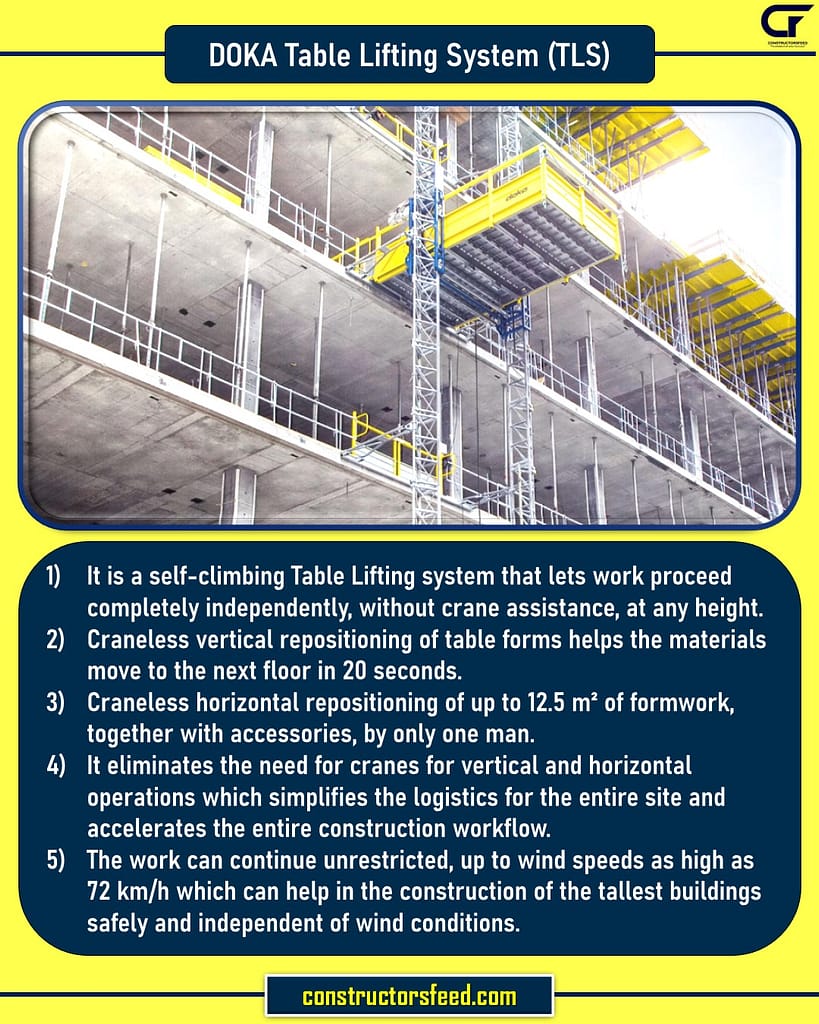
Major Projects Utilizing Doka Table Lifting System in India
1. Dwarka Cable-Stayed Bridge, Gujarat
- Overview: Doka India delivered formwork and engineering solutions for a 900 m central cable-stayed bridge—part of a larger 2.5 km highway development with four lanes and extensive retaining walls.
- Formwork highlights:
- Two “A”-shaped composite pylons rising approximately 130 m, featuring unique curvature (angled ~20°–22°).
- Used Doka’s Automatic Climbing Formwork SKE plus, along with SKE50, SKE100, SKE100 plus, Top 50 and shaft platforms—achieving crane-free, hydraulic repositioning.
- Contractor SP Singla Constructions praised Doka’s safe, customized solution and hands-on training support.
2. Minerva Tower, Mumbai
- Overview: Back in 2012, Doka supplied automatic climbing formwork (SKE50/100) for a high-rise project featuring a 12‑storey podium and twin 82-storey residential towers—highlighting early adoption of Doka’s core technologies in India.
3. Ground Freezing Method
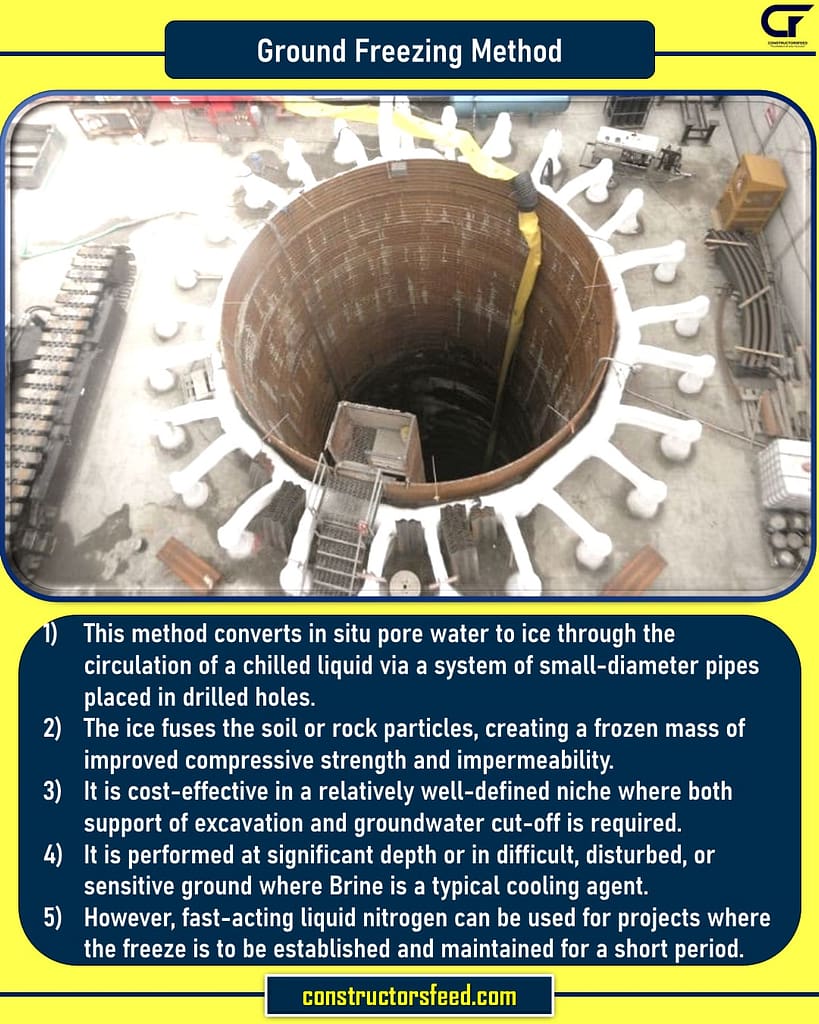
Major Project Utilizing Ground Freezing Method in India
Kolkata East–West Metro – Tunnel Under Hooghly River
- The Kolkata Metro Rail Corporation implemented a ground-freezing technique in May 2023 to stabilize soil along Nirmal Chunder Street and Wellington Square.
- This temporary soil strengthening—employing liquid nitrogen freezing via boreholes—enabled safe micro-tunnelling to connect twin tunnels with a ventilation shaft beneath the riverbed
- The process, overseen by ITD‑Cementation with Norway’s GeoFrost and Linde (liquid nitrogen provider), will take about eight months and cost roughly ₹80 crore
4. Micro tunneling
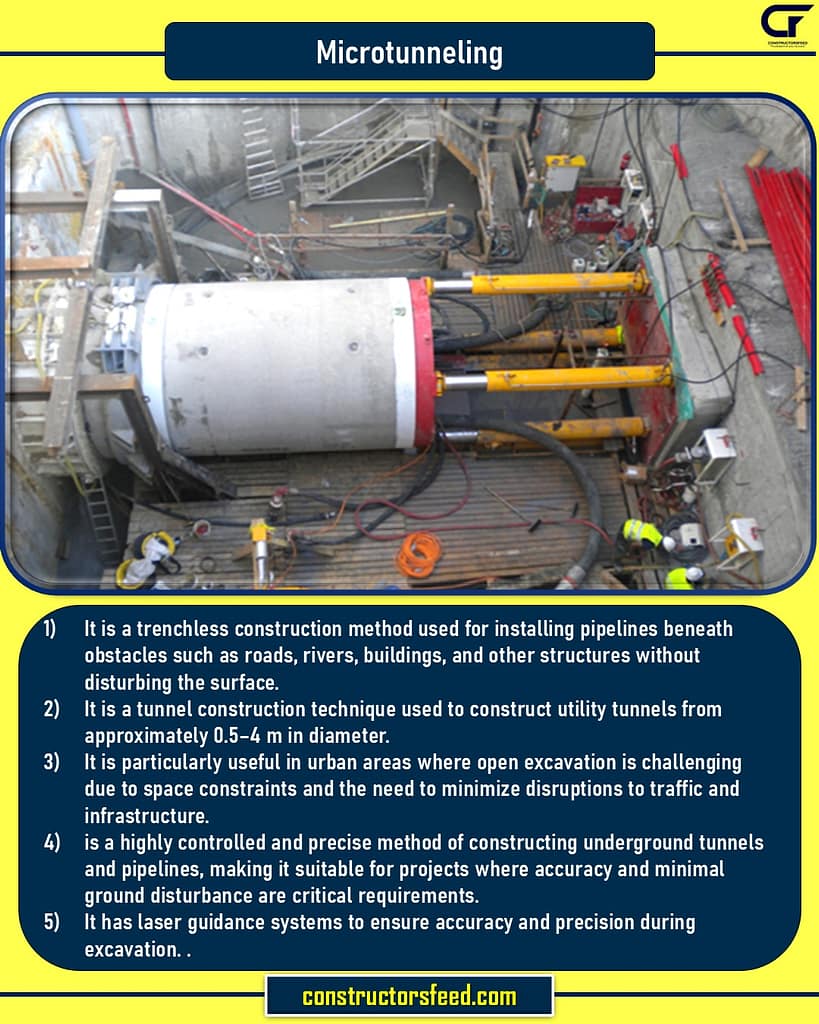
Major Projects Utilizing Micro Tunneling Method in India
1. Ahmedabad Municipal Corporation – Sewer/Stormwater Pipelines
- Micro-tunneling used to install large-diameter pipelines (up to 1 800 mm ID) over 3.62 km for sewer/stormwater systems in Ahmedabad, Gujarat.
- Also involves sea outfall and water network expansion—completion targeted around 2025
2. Delhi Jal Board – Najafgarh & Shahdara Interceptor Sewers (Delhi)
- Combined micro-tunneling lengths exceeding 11 km, deploying 900–1 600 mm diameter pipes to manage city sewage .
3. Hyderabad (HMWSSB) – Trunk Sewer Main
- A 4.5 km, 1 800 mm-diameter micro-tunnel installed for water infrastructure .
4. Delhi Metro Phase IV – Aerocity–Tughlaqabad Corridor
- TBMs bored 1.55 km tunnel using Earth Pressure Balance method, installing precast concrete rings at ~23 m depth
5. Kolkata East–West Metro – Hooghly River Under‑River Tunnel
- India’s first under-river metro TBM tunnel, 4.8 km long, drilled beneath the Hooghly River between Howrah and Esplanade, at depths up to 39 m
6. Chennai Metro Phase II – Corridor 3
- A 9 km underground segment where the 11th TBM breakthrough occurred using EPB machines under challenging geology and water-logged strata
7. Mumbai CIDCO – Fresh Water Tunnel
- Terratec’s 3.2 m diameter open TBM constructed a 6.7 km water supply tunnel in Mumbai for CIDCO, executing a complex pipeline route
5. Precast Segmental Box Girder
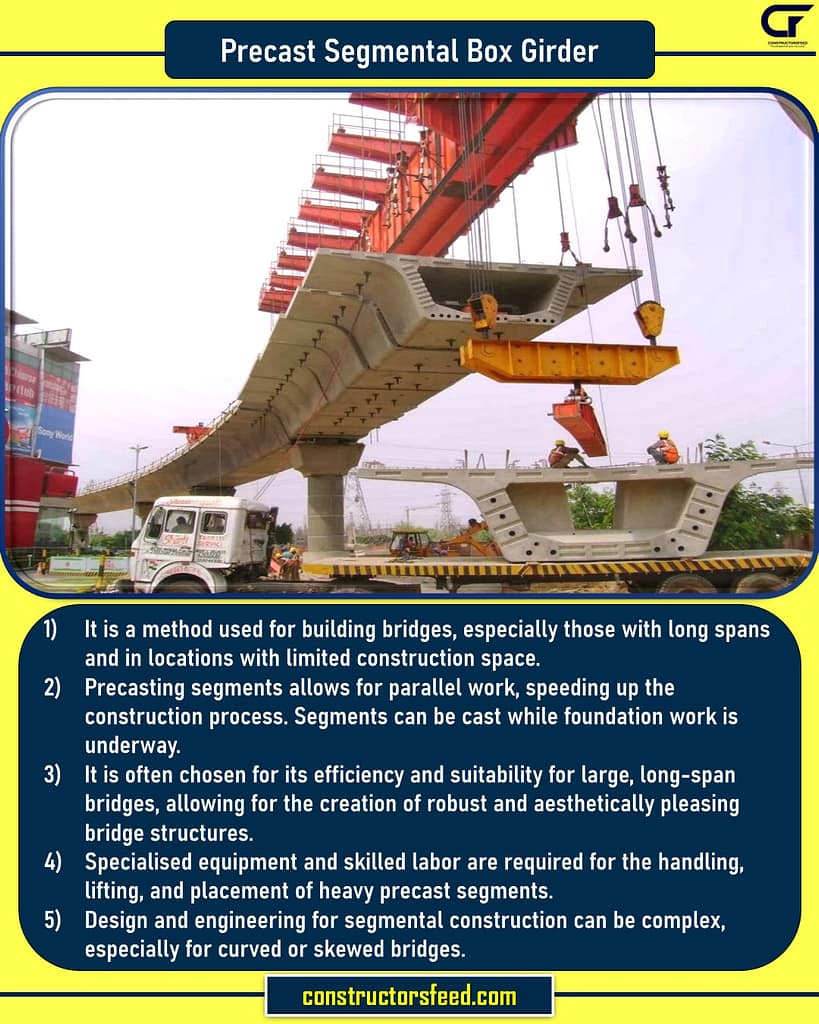
Major Projects Utilizing Precast Segmental Box Girder in India
1. Krishna River Bridge at Deodurg (1971)
One of India’s pioneering span-by-span precast box girder projects—the first major use of this method in the country
2. Delhi–Ghaziabad–Meerut RRTS Corridor
- Recently launched the first precast segmental span (~34 m) near Sahibabad/Guldhar using a launching gantry
- Demonstrates modern use of segmental methods in rapid transit infrastructure.
3. Mumbai–Ahmedabad High-Speed Rail (Bullet Train)
- Cast India’s largest 40 m full-span PSC box girders (~970 tonnes each) for the Maharashtra section
- Reflects advances in capacity and precision using precast box girder technology.
4. Chennai Metro Phase II – U-Girder Installations
- Installed the longest precast U-girder in India (33.33 m, 225 tonnes) at Ramapuram
- Utilizes cross‑section variations of box girder form for metro viaducts.
5. Sahar Elevated Access Road (Mumbai)
- Built using 35 m-long precast box‑cell segments assembled via launching girders
- Efficient construction over a congested airport-access corridor.
6. Mumbai Trans Harbour Link (MTHL)
- Features ~12,000 precast concrete box segments, assembled into 60 m spans on-site with mobile gantries
7. Diffo Bridge, Arunachal Pradesh
- A 426 m-long prestressed box girder bridge over the Diffo River, completed in 2019
6. Reverse Circulation Drilling
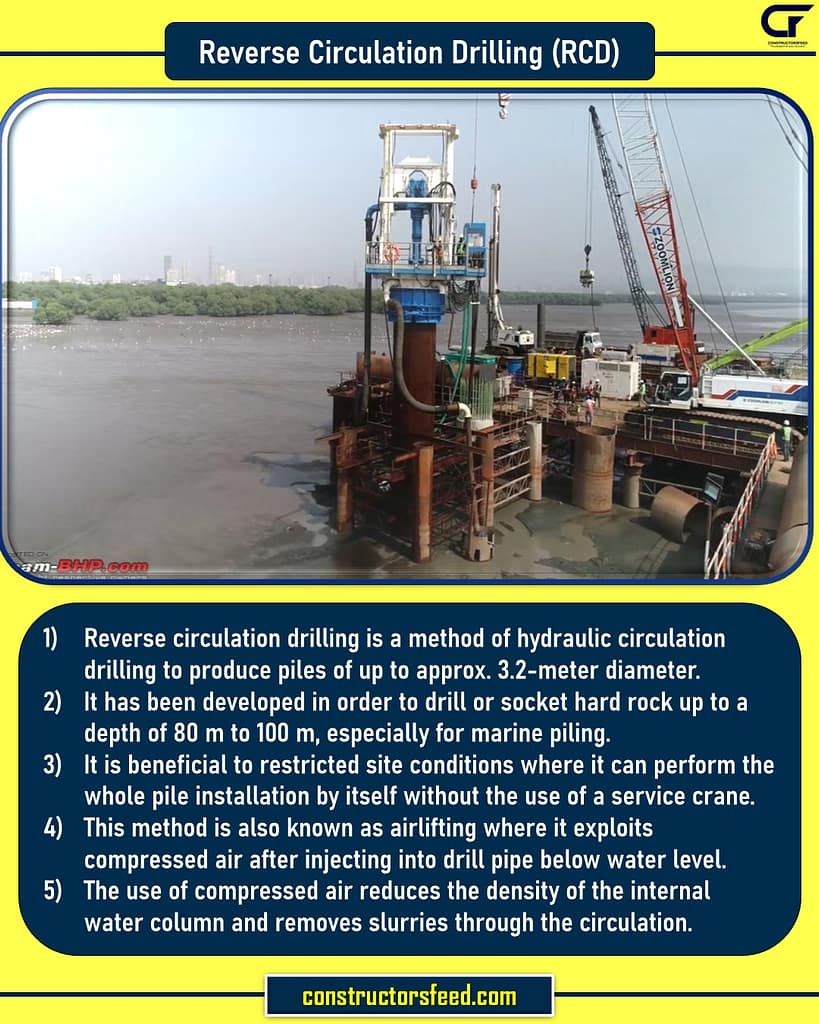
Major Projects Utilizing Reverse Circulation Drilling in India
Bandra–Worli Sea Link
Mumbai Trans-Harbour Link (MTHL): Installed 840 piles (2 m dia, 35 m deep); first-ever 3 m diameter piles using RCD in India
7. White Topping Road Construction
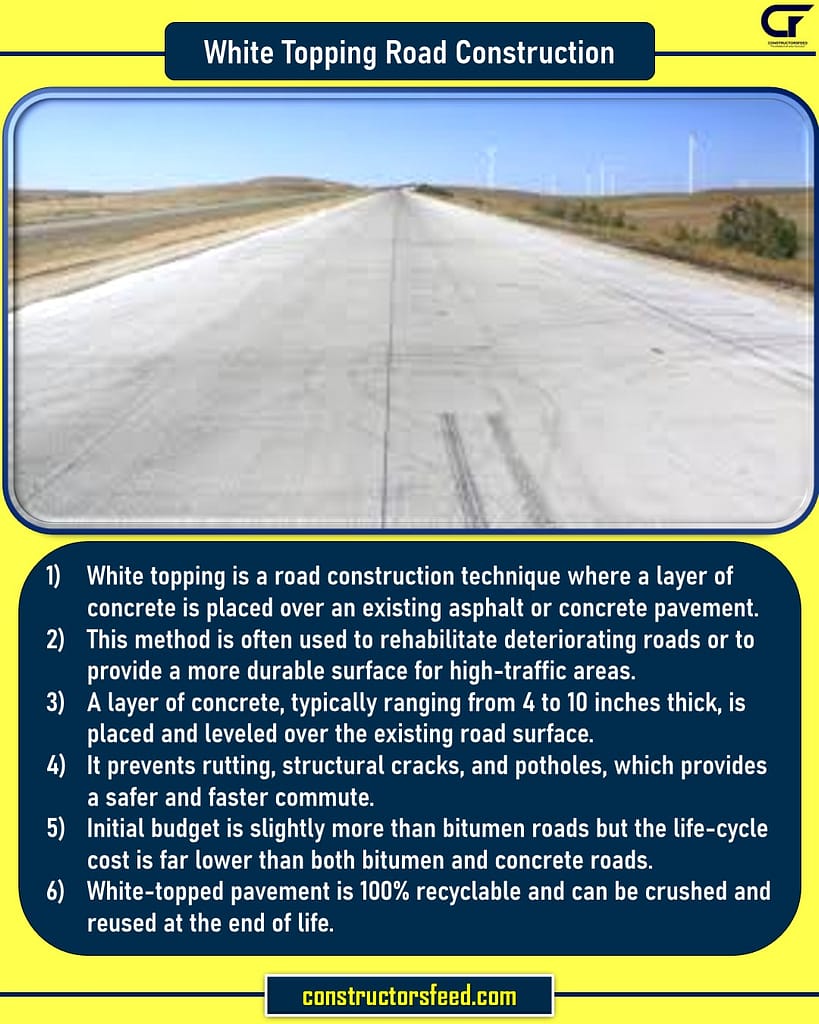
Major Projects Utilising White Topping Road in India
1. Bengaluru (BBMP initiatives)
- The BBMP launched a ₹1,700–1,800 cr white-topping programme covering 150–157 km across 97–157 roads, starting in mid‑2024, aiming for durable, pothole-resistant surfaces
- Rajajinagar → Dr Rajkumar Road saw extensive milling and overlay work, provoking traffic diversions and controls
- Works on Residency Road (Ashirvadam → Opera junction) caused major CBD gridlocks and safety disruptions in late May/June 2025
- Despite long-term goals, residents and commuters report accidents, dust, raised road levels, and uneven surfaces, with police filing a criminal case over safety lapses on Rajkumar Road
2. Goa Industrial Estates (GIDC)
- In early 2025, GIDC began white-topping internal roads across eight industrial estates (Pilerne, Honda, Verna etc.), aiming for up to 25 years of lifespan, and including utility ducts and reflective markings
3. National & State Highways
- The Mumbai–Agra (NH‑48) highway underwent white-topping over a 60 km stretch (Pimpalgaon→Gonde), featuring a ₹600 cr investment and accompanied safety upgrades near Cyrus Mistry accident site
- NH‑848 (Maharashtra) saw a 200 mm-thick thin white-topping overlay on ex–bitumen sections near Nashik-Peth, enhancing structural strength
4. Other Cities
- Kochi deployed white topping on a 5 km stretch (HMT Junction → Manalimukku) in 2019; after four years, no potholes reported
- Jaipur planned a 10 km thin white-topping in 2015 along major roads to combat frequent damage, adding drainage and fiber reinforcement
- Belagavi (2019) white-topped major city routes, using fly‑ash/polymeric fiber mixes, targeting 15–20 years of life
- Visakhapatnam and other locations—experts report ~1,000 km of PCC-overlayed roads nationwide, adding durability and reduced lifecycle costs .